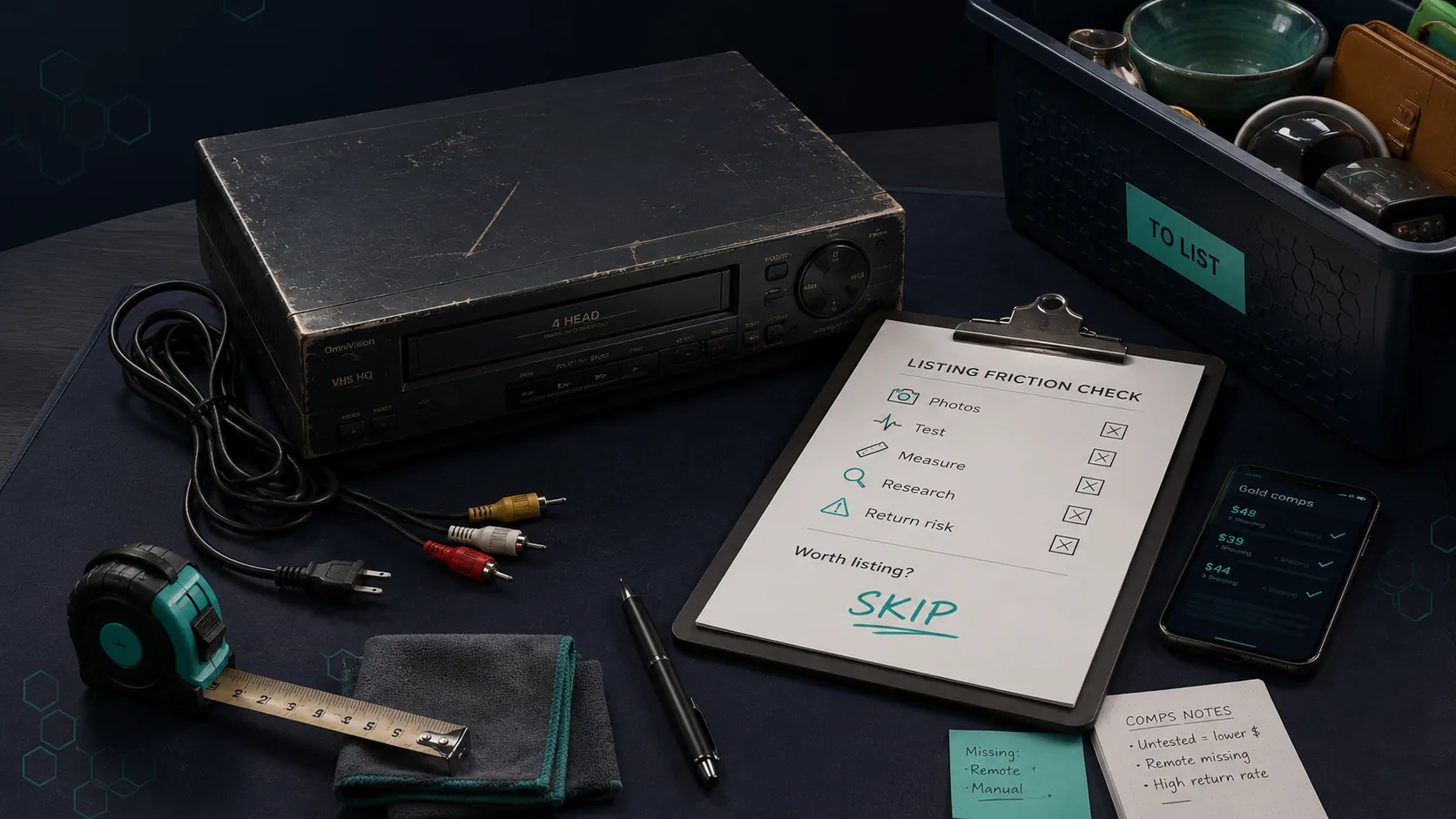
A find is only useful if the work required fits the likely return. Interesting is not the same as listable.
The mental model most resellers use is binary: price vs. comp. That's necessary but not sufficient. The comp tells you what the item sold for. It doesn't tell you what it cost the seller to get there.
Price is only the first filter
Low buy cost hides expensive effort. Before buying, think through what the listing actually needs: cleaning, testing, measuring, authenticating, sourcing replacement parts, or writing a long condition explanation to cut down on returns. If you can't sketch the listing in your head while standing in the aisle, that fuzziness usually gets worse once you're home. You set the item down on your table and it waits.
Four friction categories worth running through before anything goes in the cart:
- Photos: Does this need a mannequin, a model shot, or four angles just to show what it is? Items with complex shapes, unclear scale, or surface defects take more photography time than comparable-priced basics.
- Condition disclosure: Electronics need testing. Vintage clothing needs measurements. Anything with wear needs it documented well enough that the buyer can't claim surprise. If the disclosure work is unclear in the aisle, price it lower or leave it.
- Research load: Some categories require real background knowledge to price and describe accurately. A "vintage electronics" find that could be worth $18 or $180 depending on the exact model is a research burden. Know your categories before you pick things up.
- Return risk: Items where buyers frequently claim "not as described" eat margin through postage and restocking time. If sold comps show multiple listings with "returns accepted" explicitly called out, that's a signal worth taking seriously.
Read sold comps for workload clues, not just price
Sold comps answer more than what something sold for. The listing itself tells you what the seller had to do to close it.
Look at photo count. If every comparable listing has eight or ten photos, the item probably needs them. Look at whether the description is two lines or twelve. A category where every successful seller writes a long explanation isn't one you can list fast. Look at how long items sat before selling: a dense cluster of recent solds at a consistent price is a healthy category. A sparse smattering over six months with wide price variance is a slow one.
If the comps show a tight, consistent, recent price range with short listings and clean photos, that's a well-worn reseller category. If they show a wide spread, old dates, and sellers who clearly put in a lot of work, factor that in before you buy.
Protect the listing queue
The queue is a constraint. It is not a staging area for items you'll get to someday.
Every item in your listing backlog represents time already spent: money paid, space used, and attention that has to return to it before any of that converts. A backlog that grows faster than it shrinks stops being an asset and starts being overhead.
Before buying anything, the honest question is: does this item move to the front of my queue, or does it go to the back? If the answer is "the back, because it needs work," be honest about when the back of your queue actually clears. For most active resellers, it doesn't clear on any consistent schedule. Items that need special handling get pushed by easier wins, and then they sit.
That is not a discipline failure. It is a systems failure. The buy decision is where the outcome was already decided.
A one-line test you can use in the aisle
Before anything goes in the cart, finish this sentence: "To list this, I need to..."
If you can finish it in a few words, "measure the waist, check the zipper, take four photos," that's a listable item. If the sentence trails off or turns into its own list, set it down. The comp price you found doesn't matter if the listing never gets built.
Weekly rule
Before the next sourcing trip, write one rule for your listing floor. It doesn't need to be sophisticated. A useful format: "I will pass on [category or condition] unless [specific condition that makes the work worth it]."
Examples: "I will pass on untested electronics unless the comp price is over $40." "I will pass on anything that needs measurements unless it's a brand I know well." "I will pass on items with missing hardware unless I can spot a parts source in thirty seconds."
One rule you wrote yourself will do more work than any general principle. The goal isn't perfect judgment under fluorescent lights. The goal is fewer decisions you have to remake.